
ServiceTitan, done the way it should have been done the first time.
We came up inside a large multi-trade shop running ServiceTitan at full scale. That's the lens we bring to every implementation, cleanup, and coaching engagement. Real operations first, software second.
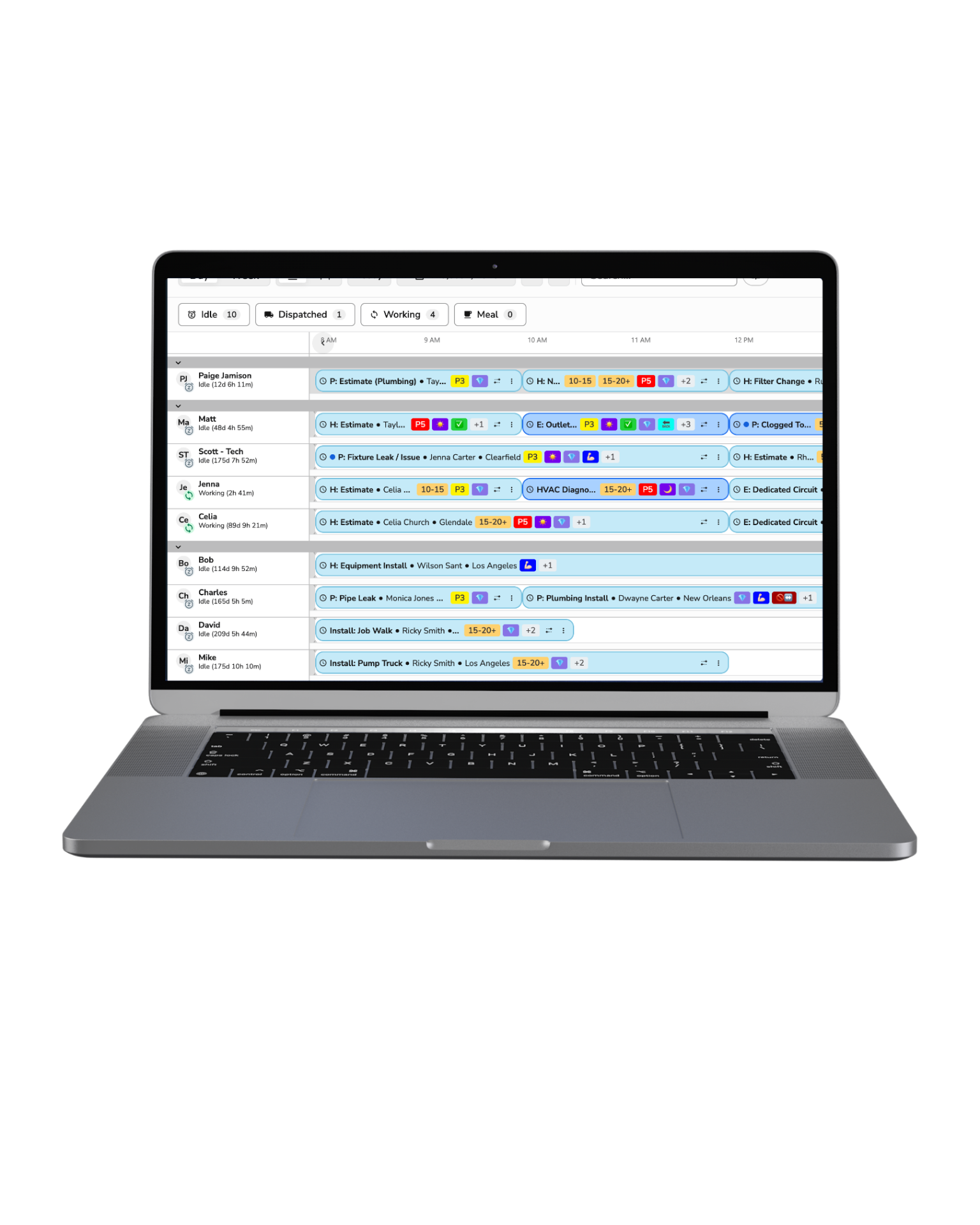
Where we plug in
New implementations
Stand up ServiceTitan the right way the first time. Tag trees, business units, memberships, price book, payroll, and integrations built to match how your shop actually runs.
Learn moreCleanup & rescue
Take an implementation that's been half-configured for two years and turn it into a system your team can trust. Fix what's broken, retire what isn't used, document the rest.
Workflows
Job types, tag automations, memberships, follow-up sequences, and CSR/dispatch flows written down and wired up. Not stuck in someone's head.
Payroll & accounting
Timesheet rules, pay structures, GL mapping, and QuickBooks sync configured so Friday afternoon stops being a fire drill.
Reporting
Dashboards and reports that show owners and managers what's actually happening, not what the software thinks is happening.
Integrations
Follow-up tools, automation glue, and the AI systems that plug into ServiceTitan without breaking anything you already rely on.
Training tracks for the people who actually work the desk.
Configuration matters, but the people using ServiceTitan matter more. Our Academy builds the CSR, dispatcher, and hybrid-seat skills that decide whether the software pays for itself.
CSR training
Inbound booking, objections, cancellation saves, outbounding, inside sales, and the daily rhythm behind them.
Dispatcher training
Debriefs, dynamic board management, callbacks, invoice review, and the operating rhythm of a profitable service board.
Hybrid CSR / dispatcher
Built for shops where one seat does both jobs. Triage rules, the Minimum Viable Dispatch routine, and a right-sized blend of both tracks.
See where your account is leaking money.
An 85+ point review of your account, scored and color-coded, with dollar amounts on the biggest gaps and a walkthrough call to go through it together.
How we actually build SOPs and rebuild ServiceTitan workflows.
No canned methodology. No 40-page deck. This is the seven-step arc every engagement follows, from the first conversation to a system your team can run without us in the room.
Start with a conversation
We sit down with owners and managers to hear how the shop actually runs today.
Before we touch a single setting, we want to understand the business. Not the org chart version. The real version. How work moves, where it stalls, what people quietly work around. That conversation shapes everything that comes next.
Start with a conversation
We sit down with owners and managers to hear how the shop actually runs today.
Before we touch a single setting, we want to understand the business. Not the org chart version. The real version. How work moves, where it stalls, what people quietly work around. That conversation shapes everything that comes next.
Dissect the existing workflow
We ask why the current process was built the way it was. Every 'bad' process had a reason.
A workflow that looks broken usually isn't stupid. It was built by someone solving a real problem with the information they had at the time. Understanding the original 'why' is how we rebuild something better without accidentally breaking what was working.
Dissect the existing workflow
We ask why the current process was built the way it was. Every 'bad' process had a reason.
A workflow that looks broken usually isn't stupid. It was built by someone solving a real problem with the information they had at the time. Understanding the original 'why' is how we rebuild something better without accidentally breaking what was working.
Talk to the team, then observe
One-on-one interviews with the people doing the work, then we watch it happen live.
Managers know what should be happening. The team knows what actually happens. Both matter. Then we shut up and watch. Where do they click? Why there and not here? What are the workarounds, the edge cases, the 'what we do when the system glitches out' moments? That's where the real process lives.
Talk to the team, then observe
One-on-one interviews with the people doing the work, then we watch it happen live.
Managers know what should be happening. The team knows what actually happens. Both matter. Then we shut up and watch. Where do they click? Why there and not here? What are the workarounds, the edge cases, the 'what we do when the system glitches out' moments? That's where the real process lives.
Rebuild with software as the scaffolding
New systems, wired into ServiceTitan with checks that verify the process is actually being followed.
A workflow is only as strong as the system monitoring it. You can design the perfect process, but if nothing verifies the team is following it, you can't guarantee it's even being used. We build the checks in, not bolted on.
Rebuild with software as the scaffolding
New systems, wired into ServiceTitan with checks that verify the process is actually being followed.
A workflow is only as strong as the system monitoring it. You can design the perfect process, but if nothing verifies the team is following it, you can't guarantee it's even being used. We build the checks in, not bolted on.
Document with a clean SOP
A high-level, step-by-step reference. Not a training manual. Something you can print, bind, and hand to a new hire.
Our SOPs are lean on purpose. No screenshot bloat, no walls of text. Just the steps, in order, at the level of detail a working operator actually needs. This is the book of systems that lives on the shelf and gets pulled down when someone asks 'wait, how do we do this again?'
Document with a clean SOP
A high-level, step-by-step reference. Not a training manual. Something you can print, bind, and hand to a new hire.
Our SOPs are lean on purpose. No screenshot bloat, no walls of text. Just the steps, in order, at the level of detail a working operator actually needs. This is the book of systems that lives on the shelf and gets pulled down when someone asks 'wait, how do we do this again?'
Train the team
Everyone bought in, clear on the process, and shown exactly where the documentation lives.
Training isn't a one-time meeting. We make sure every role that touches the workflow understands it end to end, knows why it works this way, and knows where to go when they get stuck. Buy-in is the difference between a process that lasts and a process that quietly gets abandoned.
Train the team
Everyone bought in, clear on the process, and shown exactly where the documentation lives.
Training isn't a one-time meeting. We make sure every role that touches the workflow understands it end to end, knows why it works this way, and knows where to go when they get stuck. Buy-in is the difference between a process that lasts and a process that quietly gets abandoned.
Build redundancy
No single-point-of-failure roles. What happens when your one payroll person goes on a three-week vacation?
A process only one person can run isn't a process. It's a liability. We make sure critical workflows have at least two people trained, documentation that stands on its own, and enough cross-coverage that the business keeps moving when life happens.
Build redundancy
No single-point-of-failure roles. What happens when your one payroll person goes on a three-week vacation?
A process only one person can run isn't a process. It's a liability. We make sure critical workflows have at least two people trained, documentation that stands on its own, and enough cross-coverage that the business keeps moving when life happens.
Virtual is one thing. In-person, you see things Zoom can't show you.
There's a physicality to how people work, even in an office role. Which screens are up. Who they walk over to when a job won't close. What paper is still on the desk that should have been retired two software rollouts ago. You catch it in the room. You do not catch it on a webcam.
On-site also means ridealongs. We climb in the truck with your techs and watch the job from dispatch to invoice. That's where the field-side gaps live, and it's where good SOPs and clean ServiceTitan setups make the biggest difference.
Certifications & tools we specialize in
Every certification is earned directly through ServiceTitan's own coaching program. Not self-awarded, not badge collection. It's how you know the work behind them is real.